- The Perth property market will rise 20% from here this year
- Across Australia, the property market has a long way to go, as interest rates look set to remain low
- The market will keep rising through 2023, although rate of growth will likely slow
The property market will go up this year, probably 20% in Perth, and the rise will keep going, as long as interest rates stay low.
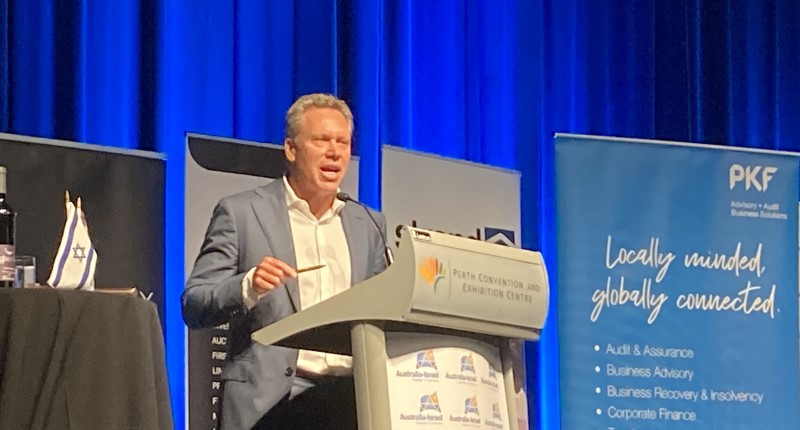
That was the main message coming out of the Australian Israeli Chamber of Commerce property event this morning in Perth.
CoreLogic’s Head of Research Asia Pacific Tim Lawless and property commentator Gavin Hegney took the in-person and online audiences through all the latest statistics.
“As I always say, fundamentals start the boom, and speculation ends it,” remarked Gavin Hegney to a capacity crowd at the Perth Convention Centre.
“We have a long way to go yet. You may think things are a bit silly, with 50 to 100 people through a home open and five or more offers per property, but we’re not yet at the silly stage.”
Given that Perth property prices fell for six years prior to 2020, including a couple of “false starts”, the busy market was welcome, but would only get us back to 2014 prices if it rose 20% or more.
“We’ll have 20% price rises across the board in Perth,” said Hegney. “I was talking 10-15% a few months ago, but now I believe it will be 20% from here.”

CoreLogic’s Tim Lawless agreed.
“Yes, the property market still has a long way to go, across the country,” he said on video stream. “The market has momentum, and we won’t see house prices fall until interest rates rise. Economic conditions are improving quickly and consumer sentiment is buoyant. The recovery trend is very much baked in.
“The RBA has been saying interest rates are on hold until 2024, so if that happens, we will see house prices continue to rise throughout 2021, 2022 and 2023, but probably at a slower rate than presently.”
“I doubt we will see the current rate of price increases remain – they are not sustainable. So a persistent but gradual fade in price rises is probably what we will see,” Mr Lawless said.
Perth was seen as a “cheap” market, where once it had been the most expensive capital city in the country. At the moment, its median price is about half that of Sydney, at $500K.
That Perth median price could rise $100K this year, which would be +20%. Even then it would be 40% lower than the harbour city.
~~
Before investing in any asset, please do your own independent research, taking into account your own personal financial situation. This article does not purport to provide financial or investment advice. See our Terms of Use.