- Home buyers run quotes through AI meaning transparent, itemised pricing is what passes the test.
- Company stability has become the buyer's first question, and a proven track record is the best answer.
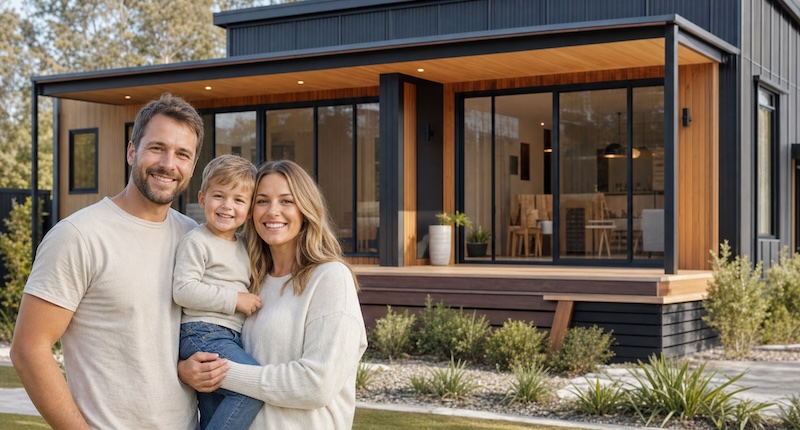
- Modular construction is rewriting the knockdown rebuild, cutting time out of home from years to weeks.
Somewhere in Victoria right now, a home buyer is pasting a builder’s sales estimate into an AI chatbot and asking it to find the catch.
Laurie Raikes has made his peace with that. “Of course, the first thing a client does with a sales estimate is stick it into AI and get it to pick the eyes out of it,” says Raikes, who leads marketing and sales at Anchor Homes, the family-owned business that has built modular homes at its factory in Victoria’s Gippsland region for two decades. “You have to be transparent, because if you’re not, AI will pick up on that pretty quickly.”
It is a small habit that captures a big shift: the customer sitting across the table in 2026 arrives with more information, sharper tools and less patience for spin than ever before. For Raikes, that is less a threat than the market finally rewarding the way his family has always tried to do business.
Trust, after the storm
Raikes is quick to qualify his vantage point. “We’re in a bit of a niche market,” he says of Anchor Homes, which designs and builds its homes at its Stratford factory before delivering them to sites across Victoria and southern New South Wales.
Even from that corner of the market, the story of the past five years is a familiar one. “The challenges are well documented,” he says. “Coming out of the pandemic, the supply chain issues we had, cost increases, and then a dive in consumer confidence because a lot of builders were going broke. We were lucky that we’re managed well and weren’t affected by that. But there’s a lot more trust required from clients now, because there’s that backdrop of people going broke and price hikes.”
Conditions have steadied since, without fully recovering. “Pricing’s a lot more predictable and confidence has returned, but it’s nowhere near pre-pandemic,” Raikes says.
“Twelve to eighteen months ago, people were really nervous to do anything because of interest rates. Now we’ve seen where interest rates are at, they’re not about to drop, and people are just starting to accept that.”

The buyer who arrives armed
What has changed most, in Raikes’ telling, is the state of the buyer’s homework. “As far as AI is concerned and making comparisons, buyers can be a lot more informed,” he says.
“The depth of analysis is a lot deeper than a quick Google search. People are very well researched by the time they speak to you, and it’s more about finding them a solution rather than selling who you are.”
“People are very well researched by the time they speak to you. It’s more about finding them a solution rather than selling who you are.”
Laurie Raikes, Anchor Homes
That leaves nowhere to hide on price. “If there is smoke and mirrors in the way a builder structures their pricing, clients can see through it,” he says. Anchor’s response has been to itemise everything and front-load the work.
“We put a lot of work in upfront with our clients to understand their project, so we’re not quoting a base price and then adding a whole bunch of options towards the end and the project becoming unaffordable.”
And when buyers do ask questions, one theme dominates. “If there’s a trend, it’s around the stability of the company,” Raikes says.
“We’ve been in business for over 20 years. We got through the GFC, we got through the pandemic. That’s a little bit of assurance that we can ride a bad storm and we’re a solid partner.”
The harder task, he admits, is conveying that stability without protesting too much: showing “people that you are stable without saying, ‘hey, we’re fine’, which comes off a bit insincere”.
Asked whether that stops short of showing clients the balance sheet, Raikes laughs. “Don’t worry, we’ve been asked for that.” It is the sort of request that would rattle a shakier operator; for a family business into its third decade, it is just the modern buyer doing due diligence, and the kind of test Anchor is built to pass.
Building the new home before the old one comes down
If transparency answers the question of who to trust, Anchor’s product answers a different one: what kind of home to build in the first place. As a modular specialist, the company competes on two fronts.
Against other modular builders, “it comes down to the company and the process, who we are, and the product”, Raikes says. Against conventional builders, the pitch is speed, sustainability and a far lighter footprint on the site.
Nowhere is that clearer than in knockdown rebuilds, a fast-growing slice of Anchor’s work. “We’re starting to build the client’s new home while they’re still living in the existing one,” he says. “In traditional construction, the first thing is demolition, and then you’re out of your house for 12, 18, 24 months depending on the builder. With us, we demo a couple of weeks prior to delivery, and after eight weeks we’re out of there. Really minimal downtime and minimal impact on the site.”
For the buyer who remains unsure that a factory-built home is the real thing, the answer is simpler still: walk through one of the display homes and, as Raikes puts it, “see that it’s a real house”.
Design in the buyer’s hands
Ask Raikes where technology is reshaping the industry fastest and he points straight to design visualisation. “It’s become so available,” he says. “Everyone can do it.” Imagery that once required specialist software and a serious budget can now be sketched by anyone in seconds, and Anchor’s clients are already doing it, generating quick AI visualisations to test ideas before a conversation has even started. “Sure, the quality’s not quite the same, but for a quick visualisation, just to look at a roof detail or something, it’s amazing.”
Inside the business, the approach is deliberately measured. Anchor has not set out to automate itself, and Raikes is in no hurry to. Where AI clearly improves things, it has earned its place – “all the obvious stuff: analysing emails, drafting emails, little bits and pieces,” he says – and the team is encouraged to experiment.
Where the work turns on a human touch, from understanding a client’s brief to walking them through a display home, it stays that way. And when it comes to the AI add-ons now appearing in the company’s drafting software, he is happy to wait.
“We’re just being a little bit cautious. I’d rather they get the beta version out first and find the bugs. I’m not keen on being the guinea pig, especially if there’s no huge upside at this point.”
It is a telling split: a buyer risks nothing by letting a chatbot interrogate a quote, while a builder gambling its production pipeline on unproven software risks a great deal. In this market, the customers are adopting AI faster than the builders.
What the smart buyer wants next
Looking ahead, Raikes expects energy performance to keep climbing the buyer’s list. Since May 2024, new Victorian homes have been required to meet a minimum seven-star energy rating under the National Construction Code, alongside a new whole-of-home energy budget.
“It’s more than just the thermal performance of the house,” he explains. “There’s a secondary component, the whole-of-home assessment, where they’re making sure you’ve got solar panels on your home, an energy-efficient hot water service and so on.”
Demand is following. “There’s a lot more request now for higher energy-efficient homes and lower running costs, and we’re seeing a bit of an uptick in what clients are looking for there,” he says. “The challenge, though, is it adds cost in an already inflated industry. It’s difficult to strike a balance.”
The value equation, at least, is easy to state. “The higher-performance home really is more comfortable, and the running costs are a lot less,” Raikes says. “But the cost to get into the house in the first place is up.”
The part no chatbot can do
Pressed for advice to the rest of the industry, Raikes demurs before offering the simplest answer in the book. “Probably not for me to be giving other builders advice, but I’d say listen. Listen to your clients and understand what they’re wanting to do. There’s nothing more frustrating than when someone pitches something to you and you think: well, you didn’t ask me that question. You haven’t really understood my needs.”
The tools buyers use to check up on builders will keep changing. What they are checking for has not changed at all: a builder who understands what they actually need, is straight about the price, and will still be standing long after the keys are handed over. On that score, Raikes is betting the way his family always has: look after the customer the whole way through, and the audit will take care of itself.
This article is based on an interview conducted by The Property Tribune. Quotes have been lightly edited for clarity and length.